
Pages load in pieces, content hides behind “show more” buttons and infinite scroll, and the sites most worth capturing — social platforms, retail review pages — are often the ones built hardest to scrape. Collecting it cleanly was never simple, and the tools litigation teams have relied on for years haven’t kept pace with how complicated that content has gotten. Static screenshot tools were built for a flatter, simpler internet, and dynamic, defended, constantly-shifting web content has mostly outgrown them.
That’s the gap WebVault, IntrepidX’s web and social media evidence collection platform, was built to close — and after a string of engagements over the past several months, the results are speaking for themselves.
The Problem With “Just Screenshot It”
A screenshot tells you what a page looked like. It doesn’t tell you that the page is what it claims to be. There’s no hash to prove the file hasn’t been altered. No server response, no timestamp verification, no record of the chain of custody between the moment of capture and the moment it lands in front of a judge. It’s a picture — and pictures are exactly what opposing counsel knows how to pick apart.
WebVault was built around the opposite philosophy. Instead of a flat image, every collection generates a structured, cryptographically verified evidence package: SHA-256 and MD5 hashes on every artifact, DNS and TLS metadata, full HTTP headers, and a signed certificate of authenticity — the kind of forensic documentation that satisfies FRE 902(14) self-authentication standards rather than hoping nobody asks hard questions about it later.
From “We Don’t Know” to “We Know Exactly What’s There”
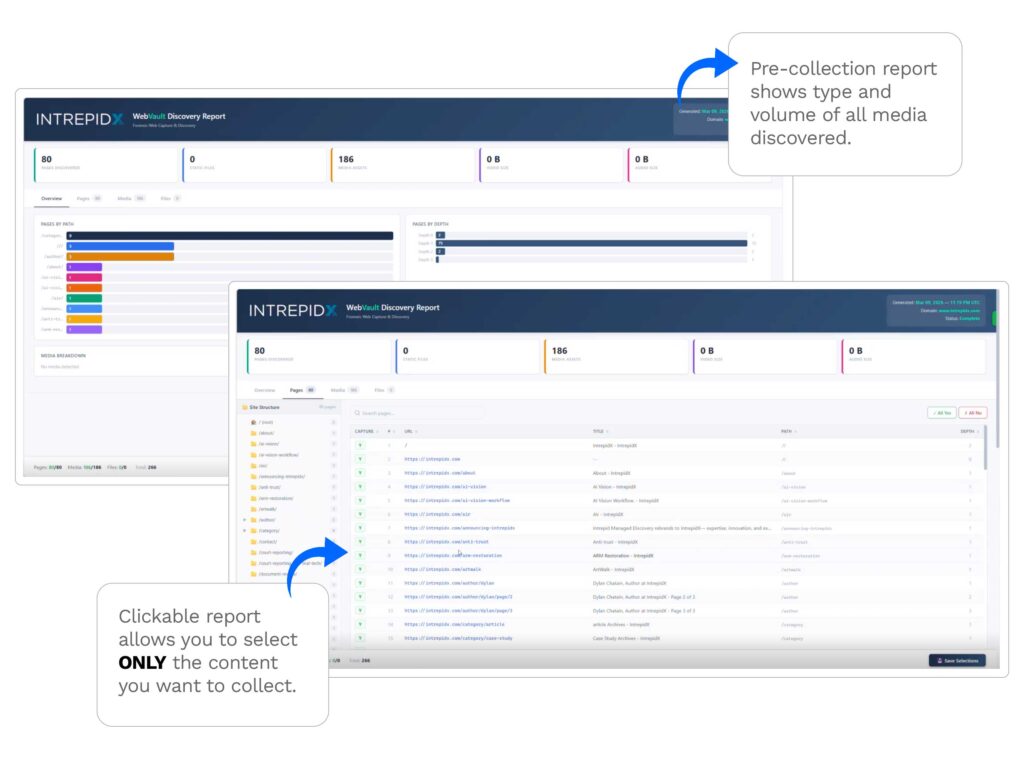
One of the most useful parts of the WebVault workflow happens before a single page is even collected. Rather than committing to a blanket capture of an entire site, WebVault can first run a discovery pass — mapping every page, file, and media asset on a target site and handing back a navigable report. A legal team can open that report, browse the site’s structure the way they’d browse a folder tree, and flag exactly what matters: this announcement, that compliance page, skip the rest.
It turns a guessing game into a scoping exercise. Instead of collecting everything and hoping the right material is buried in there somewhere, teams know what exists — and can decide, page by page, what’s worth the effort to preserve.
Built to Go Deeper Than the Competition
When a global law firm needed web and social evidence for a litigation matter, a side-by-side comparison made the difference unmistakable. A competing static capture tool identified roughly 50–60 pages on the target site, of which only a dozen or so actually contained relevant content. Using WebVault on the same target, the team identified more than 400 distinct instances of the material in question — a difference that wasn’t subtle.
That gap comes down to how the two approaches are built. Static, screenshot-based tools capture what’s visible on first load: a flat stack of PDFs, one page at a time, with no way to tell how deep a crawl actually went or what content might be sitting behind a “show more” button or a collapsed thread. WebVault is built for the way the modern web actually behaves — dynamically loaded, paginated, and full of content that doesn’t show up until you ask for it. Collapsed comments get expanded. Infinite-scroll feeds get fully captured, not just the first screen. Hidden replies get pulled in alongside the post they belong to.
The output reflects that difference, too. Rather than a stack of disconnected screenshots, a WebVault collection becomes an interactive, searchable index — sortable, filterable, and fully drillable down to individual posts, comments, and media files, all before anything gets ingested into a review platform.

“I am thoroughly impressed by the platform. IntrepidX’s WebVault provides a defensible, efficient solution for collecting and preserving web-based evidence. The platform addresses a critical gap by enabling rapid capture of dynamic online content while maintaining evidentiary integrity and chain of custody standards. WebVault streamlines web and social media preservation and reduces reliance on ad hoc or high-risk collection methods. IntrepidX’s thoughtful deliverable makes WebVault a valuable tool for any modern forensic toolkit.” — Nick Eglevsky, Director of Litigation Practice Solutions, Blank Rome
When the Evidence Is Scattered Across Thousands of Reviews
Litigation evidence doesn’t always come from a single page — sometimes it’s buried across thousands of fragments scattered around the web. In one recent engagement, a client needed to establish the exact timeframe during which a product feature had been in market, and the proof lived inside customer reviews on major retail sites. Specific mentions, scattered across years of posts, needed to be located, dated, and pulled together into a usable record — without tipping the scale by hand-picking favorable comments. The point was to let the reviews speak for themselves.
The catch: large retail and e-commerce sites are exactly the kind of environment built to resist this sort of collection. Bot detection, review pagination, dynamic loading that caps out after a certain amount of scrolling — all the friction that makes manual collection painfully slow is intentional. WebVault’s collection methods are built to work around exactly that, capturing review threads in full and re-rendering them into a single, organized document rather than the disconnected, header-fragmented mess a basic screenshot tool produces.
The team behind that engagement has come back for more than one round of it — and the collections have only grown larger each time.
“We used WebVault to pull thousands of customer reviews from multiple sites, and the results were remarkable. What would have taken us countless hours was made simple and reliable. Highly recommended.” — Cathy Pampinella, Operations Director, Daignault Iyer
Forensic Detail That Carries Into Relativity
Capturing the content is only half the job. For most litigation teams, the real test is what happens when that material needs to move into a review platform. WebVault collections are pre-built for both Relativity and Everlaw, with load files that carry over more than just text and images — page-to-page link relationships are preserved natively, so a reviewer can navigate from a parent page directly to a linked child page without losing the structural context of how the original site was organized.
Each collection also includes a certificate of authenticity, generated automatically and ready for an examiner to sign — built in as standard, not billed as an add-on.
“IntrepidX is a trusted partner that combines innovative technology with a highly dependable team of experts across the eDiscovery spectrum. WebVault and SightWords further demonstrate their ability to deliver high-impact solutions that support our complex matters” — Matthew Howard, Discovery Services Manager, Kelley Drye & Warren LLP
A Different Category, Not Just a Faster Tool
WebVault isn’t just a faster way to do what static capture tools already do. It’s a different approach entirely — one built around the reality that modern web and social content is dynamic, defended against scraping, and often deliberately temporary. Litigation teams don’t just need a picture of a page. They need a defensible, structured, and complete record of what was there, when it was there, and proof that nothing about it has changed since. That’s the gap that WebVault was built to close.
Ready to see what a WebVault collection looks like for your matter? Schedule a demo with the IntrepidX team.